
You already know what real estate tokenization is.
So, you are probably here because you are comparing companies that can build your real estate tokenization platform.
Maybe you are a real estate developer, property owner, asset manager, or investment company looking to start a business in this space.
You have already thought about your business model and decided what you want your company to offer.
Now, you need to turn that idea into a platform that can support your business from the start.
It should do more than create property tokens. Your platform also needs property listings, investor accounts, KYC, payments, smart contracts, ownership records, security, and compliance to work together.
So, where should you start?
In this guide, we will walk you through the real estate tokenization platform development process, the features you need, the expected cost, and the key things to plan before development begins.
We will also show you what to look for in a development company and why Hashcodex could be the right technology partner for your project.
Key Takeaways
- Choosing the right development company can determine whether your legal structure and smart contracts are built correctly together, helping you avoid rework later.
- Hashcodex is a real estate tokenization development company with an experienced team that can work on the SPV structure and smart contract logic together from the start.
- The cost of building a real estate tokenization platform can range from around $20,000 to over $100,000 for complete infrastructure from start to finish. The cost may change based on your specific needs.
- According to Forbes, less than 1% of global real estate value has been tokenized so far, which means the market is still wide open for early movers.
What is a Real Estate Tokenization Platform?
A real estate tokenization platform is a digital system that allows property ownership to be represented in the form of digital shares.
Instead of owning a property as a whole, it can be structured into smaller portions that investors can access based on their investment capacity. Each share represents a fractional interest in the asset.
These platforms create a structured environment where ownership is recorded digitally, making it easier to track and transfer shares between participants.
For example, a commercial property can be divided into multiple shares, allowing different investors to hold a portion of the same asset.
This approach improves accessibility in real estate while giving property owners more flexibility in how they manage and distribute ownership.
Real Estate Tokenization Development Company
Hashcodex develops real estate tokenization platforms that help property owners digitize investment opportunities, onboard verified investors, manage fractional ownership, and automate distributions.
A tokenized real estate platform connects a physical property with a legal ownership structure and blockchain-based digital tokens. Depending on the offering structure, each token can represent shares in an SPV, economic rights to rental income, debt exposure, or other defined investor rights. In many projects, the token represents an interest in the entity that owns the property rather than direct ownership of the property title itself.
Our real estate tokenization development services cover asset onboarding, smart contract development, KYC and AML integration, investor dashboards, token issuance, transfer controls, secondary market features, and post-launch support.

Why Work With a Focused Real Estate Asset Tokenization Development Company Instead of a Large Vendor?
If you have been researching this space, you may have already seen many vendors offering enterprise pricing, pre built solutions, and different use cases.
So, why could a focused development company be a better choice for your project?
Direct Access to the Team
When you work with a focused development team, you can directly communicate with the developers working on your project.
You do not have to wait in a long support queue every time you need to discuss something about the platform.
More Flexibility
Not every idea comes to you before development starts.
Sometimes, after the project begins, you may want to add a new feature or change the workflow.
A focused development partner like Hashcodex can make those changes based on your actual business needs.
Better Understanding of the Full Platform
Real estate tokenization is not only about creating tokens.
It is about connecting property owners and investors, managing investor onboarding, handling KYC and payments, and making sure smart contracts and ownership records work together.
So, if you are looking for more customization, dedicated resources, and a platform that can support your future needs, Hashcodex could be worth considering.
A Short Note From Our Management Team
Chandru Murugan, CEO:
“Businesses that succeed in this space are not always the ones with the biggest budget. RealT is one example of a company that started with an MVP and built its business around a clear tokenization model. The right technology partner should understand your business plan, not just your budget.”
Vinoth Kumar, CTO:
“I have seen teams build a token contract first and then bring in legal experts later. When the legal structure changes, they may have to change parts of the technical setup as well.
Before writing the code, we need to understand the SPV structure, who can hold the tokens, which jurisdictions are involved, and how the legal and technical parts should work together. The coding itself is not always the hardest part. Making the right legal and technical decisions before development starts is.”
Is Real Estate Tokenization Worth It in 2026?
Yes, definitely.
If you are planning to develop a real estate tokenization platform in 2026, this is a strong market to enter.
According to Investax, the value of tokenized assets started at $21 billion, and by the end of Q1 2026, it had reached $27.5 billion, representing a 30% increase in just three months.
In simple words, your platform can allow users to invest in property with small amounts, just like buying stocks.
Back in 2023, the market was around 120 billion dollars, but now demand is increasing fast from investors, startups, and real estate companies.
But before you build this platform, you should know some challenges 👇
- You need a strong legal structure because tokens are treated like securities in many countries
- You must follow strict government rules (KYC and compliance systems)
- Buying and selling tokens across platforms is still improving
- Security and smart contract safety is very important
But here’s the opportunity 👇
If you build a platform with proper compliance, easy user experience, and secure token trading, you can enter a fast-growing global market.
That’s why many startups are now focusing on real estate tokenization platform development in 2026.
Real Estate Tokenization Development: Step by Step Process
You do not need deep technical knowledge to tokenize real estate. The process follows a clear set of steps.
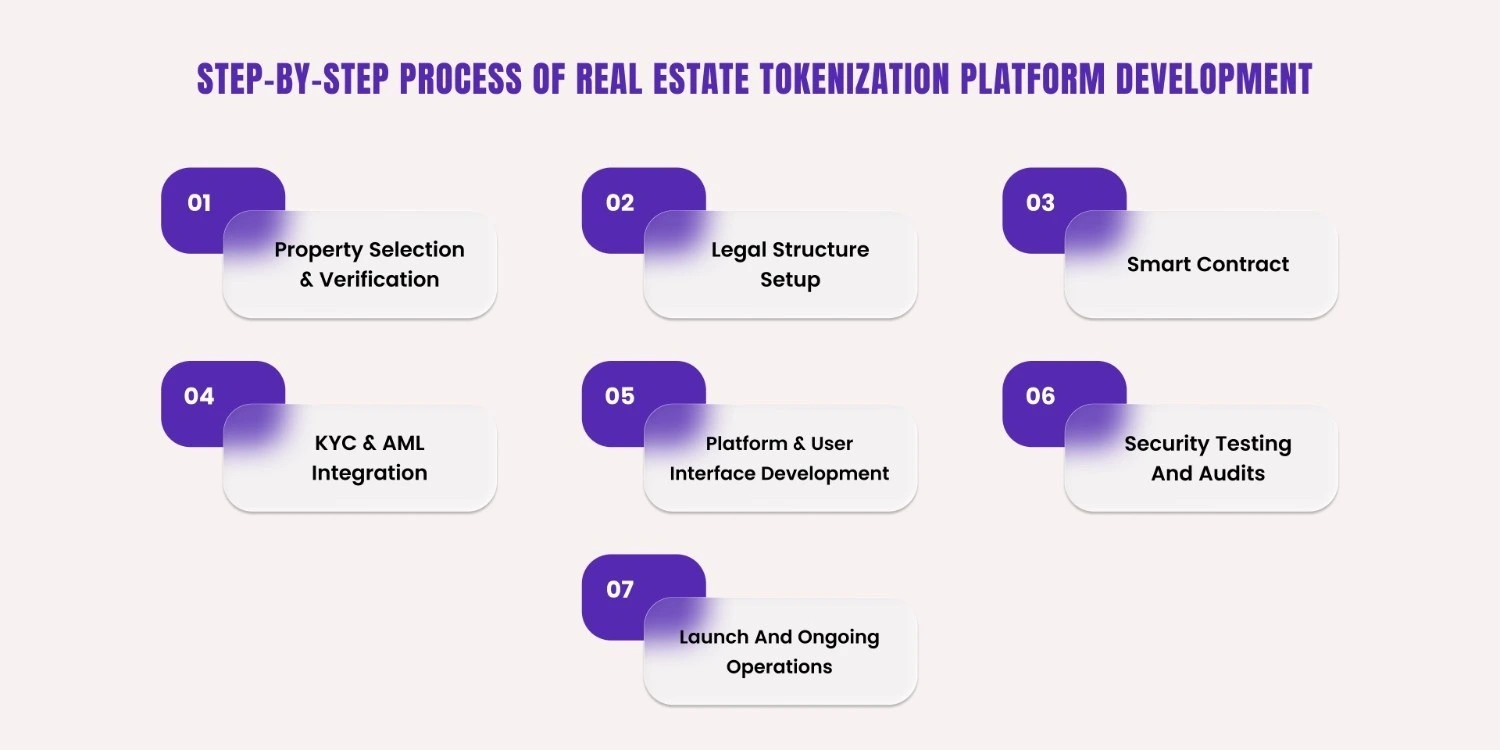
Step 1: Property selection and verification
The process begins with choosing a property that is suitable for tokenization. This step decides the quality of everything that follows.
The team checks:
- Property value and current market condition
- Ownership documents and legal clarity
- Rental income history if it is an income property
- Title verification
- Basic safety and structure condition
Once the property is verified, it becomes ready for legal structuring and platform integration.
Step 2: Legal structure setup
After the property is verified, the next step is to build the legal structure that connects the real asset with digital tokens.
This is usually done using a Special Purpose Vehicle (SPV):
- A separate legal company is created for each property
- That company holds full ownership of the asset
- Digital tokens represent shares in that company
This structure is important because it clearly defines ownership and separates each property from others in the platform.
Once the legal setup is complete, the system is ready for blockchain development.
Step 3: Smart contract development
Now the technical foundation of the platform is built using smart contracts.
These contracts handle all core actions inside the system, including:
- Creating and managing tokens
- Recording ownership on blockchain
- Distributing rental income to investors
- Controlling transfer rules
- Applying compliance conditions
Different contracts are used for different functions, such as token management, income distribution, compliance, and governance.
After development, these contracts must be carefully reviewed because they directly control financial operations.
Once the smart layer is ready, user verification is added.
Step 4: KYC and AML integration
Since real estate tokens are treated as regulated assets, user verification is required before investment.
The platform adds:
- Identity verification (KYC)
- Anti-money laundering checks (AML)
- Investor eligibility validation
These checks are usually done using tools like Sumsub, Jumio, or Onfido.
After verification, user data is linked to wallet addresses so the system can automatically enforce rules during transactions.
With compliance in place, the focus moves to building the user platform.
Step 5: Platform and user interface development
This is the part users interact with every day.
The platform is designed to make complex investment data simple and easy to use. It usually includes:
- Property listing pages with complete details
- Investor dashboard showing holdings and earnings
- Token buying and selling system
- Income reports and history
- Document storage section
- Notifications for updates and payouts
This step connects the blockchain system with a clean and usable interface.
After the platform is ready, it moves into testing.
Step 6: Security testing and audits
Before launch, the entire system is tested to avoid risks.
This includes:
- Smart contract audits
- Security testing of the platform
- KYC and AML system validation
- Legal document review
Most platforms go through two audit rounds:
- First round identifies problems and gaps
- Second round confirms fixes and stability
Once testing is complete, the platform is ready for launch.
Step 7: Launch and ongoing operations
After launch, the system continues running and needs regular management.
Ongoing work includes:
- Monitoring smart contracts
- Distributing rental income to investors
- Handling user support
- Regulatory reporting
- System maintenance and updates
A real estate tokenization platform is not a one-time build. It needs continuous attention to stay stable and grow over time.
Types of Real Estate Assets That Can Be Tokenized
Before starting a real estate tokenization platform, it is important to understand the common types of tokenization available in the market.
Each type serves a specific purpose based on investment goals, income opportunities, and property ownership preferences.
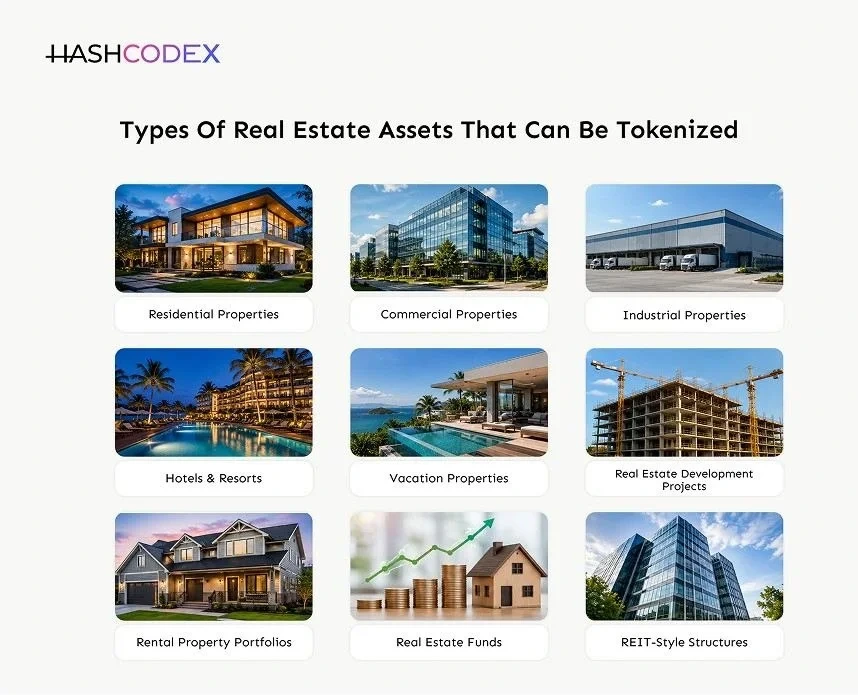
Residential Properties
Residential properties such as apartments, villas, and houses are divided into digital tokens. Investors purchase fractional ownership and receive returns based on rental income or property value.
Commercial Properties
Office buildings, retail spaces, hotels, and business centres can be tokenized. Investors gain access to commercial property markets while sharing rental earnings and future appreciation opportunities.
Mixed Use Developments
Some projects combine residential, commercial, and other property categories into one investment. This approach provides broader market exposure through a single tokenized real estate portfolio.
Industrial Properties
Warehouses, logistics centers, manufacturing facilities, and industrial parks can be included in real estate tokenization platforms. Tokenization can provide a structured way to represent fractional interests in income-generating industrial assets.
Hotels & Resorts
Hotels, resorts, and hospitality properties can be tokenized to create investment opportunities linked to property ownership, operating income, or other defined economic rights, subject to the applicable legal structure.
Vacation Properties
Vacation homes, serviced apartments, and holiday properties can be tokenized to represent fractional investment interests or defined rights associated with the underlying asset.
Real Estate Development Projects
New construction and property development projects can use tokenization to structure investment participation during development. Tokens may represent equity, debt, or another legally defined economic interest.
Rental Property Portfolios
Multiple income-generating properties can be grouped into a portfolio and represented through a tokenization platform. This can give investors exposure to a diversified collection of rental assets rather than a single property.
Real Estate Funds
Real estate funds and similar investment structures can use tokenization to digitally represent investor interests, subject to the fund's legal and regulatory framework.
REIT-Style Structures
Certain real estate investment structures can use blockchain-based tokens to represent economic interests in property-holding entities. The exact structure and regulatory treatment depend on the jurisdiction and legal framework.
Real Estate Tokenization Models: A Complete Overview
Equity Based Real Estate Tokenization
Tokens represent ownership or economic interests in a property holding entity. Investors may receive returns from rental income, appreciation, or property sale proceeds.
Fractional Ownership Tokens
A property is held through an SPV or similar entity, while tokens divide investment interests into smaller units for multiple participating investors.
Rental Income Tokenization
Tokens represent defined rights to rental income from a property or portfolio. Distributions depend on agreed terms, expenses, occupancy, and applicable regulations.
Debt or Loan Tokenization
Tokens represent interests in real estate loans instead of ownership. Investors may receive agreed interest payments while the property owner retains ownership.
Real Estate Portfolio Tokenization
Multiple properties or real estate investments are combined into one tokenized structure, giving investors exposure to different assets, locations, and income sources.
Compliance-Ready Smart Contract Development
Real estate tokenization often involves regulated financial activity. Smart contracts should support the legal and compliance rules governing token issuance and transfers.
Hashcodex develops smart contracts that can support:
- Token creation, issuance, and burning
- KYC and AML based investor whitelisting
- Transfer and jurisdiction restrictions
- Lock up periods
- Rental income or dividend distributions
- Token holder voting and governance
- Transaction records and reporting
- Emergency pause and administrative controls
For regulated offerings, standards such as ERC 3643 can support identity based transfer restrictions and compliance controls. The appropriate standard depends on the legal structure, blockchain, and business requirements.
Tokenized Real Estate vs Traditional REIT
| Factor | Tokenized Real Estate | Traditional REIT |
| Investment Focus | Exposure to a specific property or project | Usually exposure to a portfolio |
| Ownership Format | Digital tokens linked to defined legal and economic rights | Shares in a trust or company |
| Minimum Investment | Can be divided into smaller investment units | Depends on the REIT and market price |
| Transfer Process | May use blockchain based transfer workflows | Uses conventional market infrastructure |
| Compliance | Requires investor verification and transfer controls | Follows established securities and fund regulations |
| Liquidity | Depends on eligible buyers and marketplace availability | Public REITs generally offer exchange based liquidity |
Benefits of Real Estate Tokenization for Businesses
Lower Investment Entry Point
Fractional ownership allows investors to participate in real estate through smaller investment amounts instead of purchasing an entire property.
Broader Capital Access
Property owners can reach a wider pool of eligible investors across different markets through digital investment platforms.
Digitized Ownership Records
Blockchain based records provide clear visibility into token ownership, transfers, investor allocations, and distribution activity.
Automated Processes
Smart contracts can automate investor onboarding, transfer validation, income calculations, and distribution workflows.
Flexible Capital Formation
Tokenization gives property owners an additional way to raise capital through fractional investment structures.
Secondary Market Access
Tokenized assets can be offered through compliant secondary markets, giving eligible investors opportunities to transfer their holdings.
Real Estate Tokenization Development: Legal and Operational Challenges
When it comes to tokenizing real estate, one question usually comes up first.
Is this even legal?
The answer is yes, but only when the right structure is in place. Real estate tokenization operates within existing legal systems, but it requires careful planning from the start.
These challenges are not barriers. They are part of building a reliable and compliant platform.
Here are a few key areas to consider:
- Legal Ownership Structure
A property cannot be directly divided into digital shares without a proper setup.
To address this, the asset is placed under a legal entity that links ownership to tokens in a clear and accepted way.
- Regulatory Compliance
Rules for digital assets and investments vary across regions.
This is handled by structuring the token offering to follow local regulations and investor requirements.
- Market Adoption and Trust
Since this is still a growing space, some investors may take time to feel confident.
Clear communication and consistent operations help build trust over time.
- Technical Integration and Platform Reliability
The platform that manages tokens, investors, and transactions needs to work without issues.
Working with an experienced real estate tokenization development company helps ensure a stable and well-structured setup.
In most cases, these challenges are not roadblocks. They are part of building a strong foundation.
With the right setup, real estate tokenization can operate in a clear and structured way.
Key Mistakes Businesses Should Avoid During Real Estate Tokenization
1. Ignoring Legal Structure
Define the SPV, property ownership, investor rights, and token structure before development begins.
2. Poor Token Economics
Clearly define token supply, pricing, rental income, voting rights, and redemption terms.
3. Choosing the Wrong Token Standard
Standards such as ERC 3643 can support investor whitelisting, identity based transfers, and compliance controls.
4. Overlooking Secondary Markets
Plan token transfer rules, eligible wallets, approved marketplaces, and investor exit mechanisms during development.
5. Skipping Smart Contract Audits
Audit contracts handling token issuance, transfers, income distributions, and administrative controls before deployment.
6. Choosing Blockchain Too Early
Select the blockchain based on token standards, compliance requirements, transaction costs, wallet support, and the real estate investment model.
How Much Does It Cost to Develop a Real Estate Tokenization Platform?
Here is a simple cost breakdown in table format based on platform size and features.
| Development Tier | What Is Included | Estimated Cost | Timeline |
| Basic Platform | Core smart contracts, property listing UI, basic investor dashboard, KYC integration, single blockchain support | $20,000 to $50,000 | 1 to 3 months |
| Standard Platform | Multi token support, secondary marketplace, automated income distribution, multi region compliance, mobile friendly design | $40,000 to $70,000 | 4 to 6 months |
| Enterprise Platform | Multi chain system, DAO governance, institutional tools, full compliance setup, API integration, advanced security infrastructure | $80,000to $1,00,000+ | 8 to 12 months |
Conclusion
Real estate ownership is changing through tokenization. By converting property assets into digital tokens, businesses can create new investment opportunities and make ownership more accessible.
A successful tokenization platform requires proper asset structuring, smart contract integration, and compliance management. Each component plays an important role in the platform's operation.
Hashcodex supports businesses by providing RWA tokenization development solutions for real estate tokenization platforms in the USA, UAE, and Singapore, helping organizations digitize property assets and broaden investor participation.
For businesses considering property tokenization, this can be a valuable way to explore modern real estate investment models.
Interested in property tokenization? Contact our team to discuss your project.
Frequently Asked Questions
Is real estate tokenization legal?
Real estate tokenization can be legally structured, but requirements vary by country and token type. Legal professionals should determine the entity structure, investor eligibility, disclosures, and offering requirements.
Does a real estate token give direct ownership of a property?
Not always. A token may represent ownership in an SPV holding the property or provide economic rights such as rental income, debt repayment, or other defined benefits.
What is an SPV in real estate tokenization?
An SPV, or Special Purpose Vehicle, is a separate legal entity created to hold a property or project. Tokens can represent ownership interests or defined rights connected to that entity.
Which blockchain is best for real estate tokenization?
The right blockchain depends on compliance requirements, transaction costs, privacy, smart contract capabilities, wallet support, and integrations. Ethereum compatible networks are commonly considered for real estate tokenization.
What is ERC 3643?
ERC 3643 is a token standard designed for regulated digital assets. It supports identity verification, wallet whitelisting, transfer restrictions, and compliance controls for eligible token holders.
Can tokenized real estate be traded on a secondary market?
Tokenized real estate can be traded through eligible secondary markets when the legal structure, investor eligibility, transfer restrictions, and marketplace requirements permit token transfers.
How long does it take to develop a real estate tokenization platform?
A basic MVP can take around 4 to 5 months. Platforms requiring compliance automation, income distribution, multiple assets, and secondary market features may take 5 to 8 months.
How much does real estate tokenization platform development cost?
Real estate tokenization platform development starts from $15,000. The final cost depends on the token model, blockchain, compliance integrations, smart contracts, investor portal, and platform features.








 NDA on Request
 Free Consultation – Let’s discuss your ideas